
No products in the cart.
-30%
Original price was: $23.99.$16.79Current price is: $16.79.
- Discover a world of quality products.
- Multiple safe payment methods
- Quality Meets Affordability
- Risk-Free Shopping with Returns

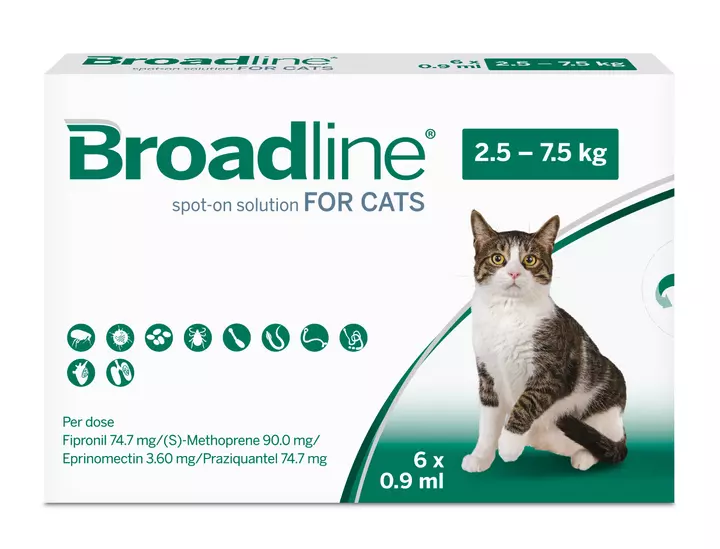
Broadline is the latest all-round parasite treatment for cats. It is easily applied to the back of the neck as a simple spot-on and then provides effective treatment against all major internal and external parasites.
It contains a range of ingredients to produce a powerful effect against fleas, ticks, internal roundworms and tapeworms. At the time of introduction, this is the widest range of parasites treated by one simple medication available for cats.
Broadline is applied once a month for complete parasite control in cats.
- Pre-Launch Information
Pre-Launch Information
A new product has taken a leap closer to joining Advocate and Stronghold in the fight to be called the UK’s ‘top feline anti-parasitic’. Merial have furthered their leading flea and tick treatments ‘Frontline’ and ‘Frontline Combo’ and taken things not one, but two steps further . In order to beat products currently seen as ‘the best’, Merial had to come up with something that does that little bit extra; Broadline is a broad spectrum insecticidal, miticidal, anthelmintic spot on, able to provide total coverage of common feline parasites.
Broadline contains four active ingredients: fipronil, (S)-methoprene, praziquantel and eprinomectin. As an E-SQP reading about this for the first time, I immediately recognised and could relate to three of the active ingredients. Eprinomectin was a new name to me but I was at least able to link it to a group of wormers, the macrocyclic lactones (MLs)- quite exciting as I realised this meant that roundworms, fleas, ticks and tapeworms were all covered in one treatment. Furthermore, MLs are also highly effective against both lice and mites, conveying greater protection as an endectoside.
I am sure SQPs who have studied the Farm Animal Module will be familiar with the Merial’s POM-VPS ‘Eprinex Pour-On’, a topical solution for cattle containing eprinomectin. If like me you hadn’t heard of it, it is still clear to see that it only seems natural to try and combine active ingredients from two successful products.
I’ve never been one to just accept that something does a job- I need an explanation because quite frankly, I would forget its importance otherwise! I started looking into eprinomectin and found that it is a semi-synthetic avermectin, indeed a derivative of MLs. In keeping with a ML mechanism of action, eprinomectin binds to invertebrate ligand-gated ion channels and in particular, has a high affinity for glutamate-gate chloride channels (GluCls) and exerts anti-parasitic properties by causing neurotoxicosis. GluCls play vital roles in feeding, locomotion and other behaviours. When a ML such as eprinomectin binds to and opens these channels, the cell membrane is made more permeable to chloride ions. Subsequent influx of ions produces hyperpolarisation of either the muscle or nerve cell and paralysis which ultimately leads to death of the parasite. Mammals do not have GluCls and eprinomectin has low affinity for other ligand-gated ion channels mammals possess. Additionally, while the chemical is absorbed into the bloodstream, it is unable to cross the blood-brain barrier and along with other MLs well known to E-SQPs such as ivermectin, is very safe.
Alongside eprinomectin’s action against the wide range of roundworms, lice and mites, the remaining three active ingredients target fleas, ticks and tapeworms. Fipronil and (S)-methoprene are renowned for their efficacy against fleas, working in different ways to break their life cycle. Fipronil acts through non-competitive inhibition of insect GABA receptors, blocking flow of ions and leaving the central nervous system uncontrolled, resulting in death of the adult fleas. It is effective against ticks in the same way. Females are sterilised by (S)-methoprene, as it mimics an insect hormone to prevent sexual development and further build up of eggs in the environment. Praziquantel delivers the final blow to the yet untouched tapeworm population, leaving them paralysed and unable to resist digestion by the host. They lose hold of their position in the gut and are either fully digested and or passed out in fragments.
| Size / Type | Small Cats up to 2.5kg » 3 Pipettes |
|---|
Be the first to review “Boehringer Ingelheim Broadline For Cats”
Related products
-30%
Original price was: $26.99.$18.89Current price is: $18.89.
-30%
Original price was: $25.30.$17.71Current price is: $17.71.
-30%

Original price was: $39.98.$27.99Current price is: $27.99.
-30%

Original price was: $22.00.$15.40Current price is: $15.40.
-30%
Original price was: $34.25.$23.98Current price is: $23.98.
-30%
Original price was: $17.99.$12.59Current price is: $12.59.
-30%
Original price was: $46.00.$32.20Current price is: $32.20.
-30%
Original price was: $24.85.$17.40Current price is: $17.40.
Reviews
There are no reviews yet.